How I Solve AI Coding Costs with Local + Cloud LLMs: Introducing MACA
AI-assisted coding only becomes sustainable when the economics and quality trade-offs are handled well. The practical answer is not to choose between local intelligence and cloud intelligence. It is to use both, deliberately.
At a high level, I work with two kinds of models:
- Local LLMs running on my laptop or workstation
- Cloud LLMs running in hosted API services
The core idea is simple: keep routine, low-risk work on the machine I already own, and reserve stronger cloud models for the tasks that genuinely need deeper reasoning.
The goal is not to use the biggest model for everything. The goal is to use the right model at the right time.
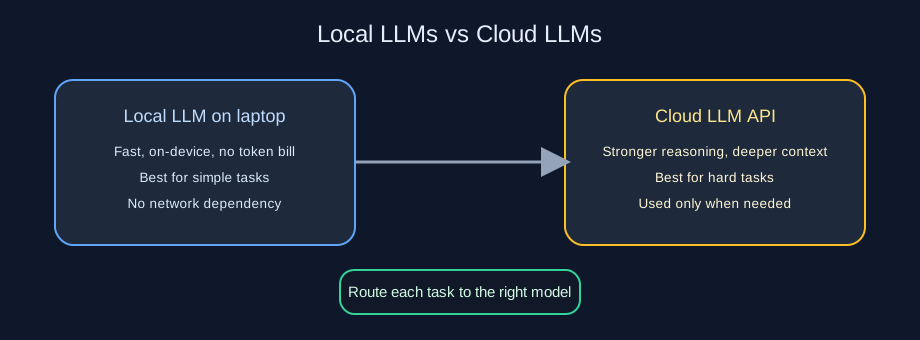
This is the model I use every day. It is not about choosing one side of the spectrum. It is about routing work to the right tier with minimal waste and maximum control.
Two kinds of AI models I rely on
Local LLMs — fast, offline-ready, free
Local models run directly on the machine I already own. They are useful for:
- boilerplate and scaffolding
- small refactors
- file inspection
- tests and simple code generation
- offline work when network connectivity is limited
The main benefit is practical: these tasks can be completed without token usage, API billing, or network dependency.
Cloud LLMs — stronger reasoning when needed
Cloud models are still valuable for:
- multi-file reasoning
- larger architectural decisions
- complex debugging
- formal technical specifications and deeper code review
These are the moments where a larger model gives noticeably better results than a local one.
What MACA is
Multi-Agent Coding Assistant (MACA) is the local-first, hybrid CLI assistant I am building to combine local and cloud models into one practical workflow.
A team of specialized agents, not just a prompt box
MACA is an agentic AI system, not a single prompt box. Instead of asking one model to do everything in one shot, it coordinates a small team of specialized agents through a high-level pipeline:
- Classify & Clarify: assesses task complexity and, for greenfield projects, asks quick clarifying questions (such as stack, runtime, or build tool) before writing code
- Plan & Spec: inspects the workspace, creates a structured plan, and—for medium or complex work—drafts a technical specification and pauses for human approval before implementation starts
- Implement, Verify & Review: generates code into an isolated staging area, checks that every planned step is actually complete, and runs an automated review-and-fix loop
- Promote Safely: only applies changes to the real workspace once the review passes, keeping the repository clean until the code is ready
This matters because software work is rarely a one-shot action. Real tasks need clarification, planning, verification, and review. Modeling that flow across specialized stages produces far more reliable output than a single monolithic prompt.
Tiered routing with built-in fallbacks
Before work begins, MACA’s router matches the task’s complexity to the right model tier:
- Simple tasks → Local Gemma via Ollama (fast, free, on-device)
- Medium tasks → Google Gemini (fast, strong reasoning)
- Complex tasks → Anthropic Claude (deepest reasoning for harder architecture and multi-file work)
If a cloud provider or local Ollama instance is offline or unconfigured, MACA falls back gracefully to the next available tier—and you can always override the model manually when you want to.
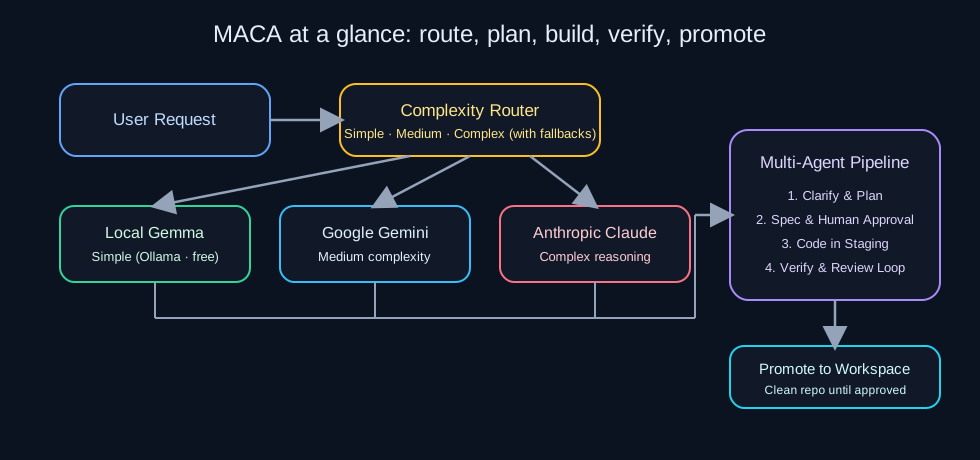
This high-level architecture keeps the experience fast, affordable, and safe in real development work, with complexity-based routing up front and a clean staging boundary before changes touch the repository.
How I solve the token and cost dilemma
1. Solve simple tasks locally — for free
For straightforward tasks, MACA routes to a local Gemma model running through Ollama. This is ideal for:
- file inspection
- boilerplate generation
- small refactors
- test scaffolding
- routine code suggestions
Result: no token usage, no AI billing, and no external API dependency for routine work.
2. Escalate in tiers only when the task demands it
When the task needs stronger reasoning, MACA steps up to cloud models—Gemini for medium complexity, and Claude for the hardest problems.
This is a much better economic model than sending every request to the most expensive frontier model by default.
3. Keep the workspace safe while iterating
Multi-step agent loops are only useful if they do not leave half-finished code scattered across your repo. By staging changes, verifying completion, and running an automated review loop before promoting files, MACA keeps iteration contained and predictable.
Why spec-driven development makes this practical
The real unlock is not just the model itself. It is the way the work is broken down.
With a spec-driven workflow, work is sliced into smaller, well-defined tasks—and for anything non-trivial, you review and approve the specification before code is generated:
- simple edits → skip the heavy spec step and stay on the local model
- medium and complex features → agree on a clear spec first, then route to the right cloud tier
- verification and review → catch missing pieces and quality issues before files ever land in your workspace
In many real coding sessions, a large share of routine work stays local, while cloud intelligence is focused where it adds the most value.
Why this works in practice
Splitting work across local and cloud tiers changes the economics and reliability of day-to-day AI coding:
- Zero token spend on routine work — local compute handles the high-volume basics
- Selective cloud usage — frontier models are reserved for the moments that genuinely need deeper reasoning
- Human-in-the-loop control — specs, verification loops, and clean workspace promotion keep agentic runs predictable
That is why I built MACA. It is not just another chat wrapper — it is a practical way to make AI coding faster, more affordable, and more sustainable on the machine you already own.
A note on modern hardware (and the path to full privacy)
The hardware trend is also important here. High-memory developer machines like the Microsoft Surface Laptop Ultra, Surface RTX Spark Dev Box, and Apple M-series Max laptops with unified memory and strong GPU bandwidth prove that serious local AI workloads are already practical on real developer hardware.
My own experience shows both ends of that spectrum: MACA is already practical on an Apple M3 Pro (18GB) laptop, and on a standalone Apple M1 Max I run heavier models locally over Ollama and hardly need to touch cloud models at all.
It is worth being honest about privacy today: as soon as a hybrid workflow escalates a task to a cloud model, it is no longer private. Today’s hybrid approach is primarily about cost and efficiency. However, as local hardware gets more compute and memory—and local models keep closing the gap—this same architecture is a natural stepping stone to a future where all tiers run locally and the entire coding workflow can be genuinely, fully private.
The takeaway
The best AI-assisted coding experience is not the one that uses the biggest model for everything. It is the one that uses the right model at the right time—with the right guardrails around it.
That is the mindset behind MACA:
- Solve simple tasks on local compute — for free
- Escalate across cloud tiers only when the task really demands it
- Use specs, verification, and staging so agentic workflows stay reliable
That is how we make AI coding cheaper, faster, and more trustworthy.
Try it out & contribute
MACA is open source and in active alpha development on GitHub: GSSwain/multi-agent-coding-assistant.
If you’re interested in local-first AI workflows, hybrid routing, or multi-agent systems, I’d love your help — contributions, feedback, bug reports, and PRs are all welcome!